


i search through the internet to know what exactly the greatest car of all times is..well there's so many of it though..lol
but as far as i know, here's the list of 100 greatest car,Greatness, for the reason of this list, is defined by a vehicle's direct, significant contribution to American automotive culture. That does not mean that a car had to actually have been sold in America, but that its legend changed how other cars are seen in its shadow. Some of the choices here are actually racecars.
so here it is
good day folks..
this car is amazing..it has a really sport look that time, i really like the spec of this corvette sting ray n apparently im not the only 1 who love this car when i see that they build the reincarnation of the classic corvette sting ray in 2014..read this..and this is the look of the 2014 Sting Ray

i search through the net n i found the classic sting ray spec..check this out
 The 1963 Corvette Sting Ray offered the top 360-hp fuel-injected 327 V-8 and the equally desirable four-speed manual gearbox. |
| Vehicle Specifications | Convertible | Coupe |
| Wheelbase, inches | 98.0 | 98.0 |
| Length, inches | 175.3 | 175.3 |
| Width, inches | 69.6 | 69.6 |
| Track, inches | front: 56.3 rear 57.0 | front: 56.3 rear: 57.0 |
| Height, inches | 49.8 | NA |
| Curb weight, pounds | 3,150 | 3,150 |
front: Independent; upper and lower A-arms, coil springs, antiroll bar, tubular hydraulic shock absorbers
rear: Fixed differential, U-jointed half shafts, lateral struts, radius rods, transverse leaf spring, tubular hydraulic shock absorbers, antiroll bar w/big block engines
6.70x15
front: 11-inch drum
rear: 11-inch drum
3-speed manual (std)
4-speed manual (opt)
2-speed Powerglide (opt)
3.70:1
| Type | ohv V-8 | ohv V-8 | ohv V-8 | ohv V-8 |
| Displacement, liters/cu inch | 5.35/327 | 5.35/327 | 5.35/327 | 5.35/327 |
| Bore x stroke, inches | 4.00 x 3.25 | 4.00 x 3.25 | 4.00 x 3.25 | 4.00 x 3.25 |
| Fuel Management | 1 x 4-bbl. | 1 x 4-bbl. (AFB) | 1 x 4-bbl. (AFB) | fuel injection |
| Horsepower @ rpm | 250 @ 4400 | 300 @ 5000 | 340 @ 6000 | 360 @ 6000 |
| Torque @ rpm, pound-foot | 350 @ 2800 | 360 @ 3200 | 344 @ 4000 | 352 @ 4000 |
| Acceleration | 300 hp, 4-sp man. |
| 0-60 mph, sec | 6.1 |
| 0-100 mph, sec | 14.5 |
| 1/4-mile, sec @ mph | 14.5 @ 100 |
| Car Type | Production | Price |
| 2-door convertible | 10,919 | $4,037.00 |
| 2-door coupe | 10,594 | 4,252.00 |
Options and Production
| Option | Production | Price |
| Leather Seats | 1,114 | $80.70 |
| Sebring Silver Exterior Paint | 3,516 | 80.70 |
| Soft Ray Tinted Glass, all | 629 | 16.15 |
| Soft Ray Tinted Glass, windshield | 470 | 10.80 |
| Power Windows | 3,742 | 59.20 |
| Auxiliary Hardtop | 5,739 | 236.75 |
| Heater and Defroster Delete (credit) | 124 | 100.00 |
| Air Conditioning | 278 | 421.80 |
| Positraction Rear Axle, all ratios | 17,554 | 43.05 |
| Highway Rear Axle, 3.08:1 | 211 | 2.20 |
| Power Brakes | 3,336 | 43.05 |
| Sintered Metallic Brakes | 5,310 | 37.70 |
| 300 hp Engine | 8,033 | 53.80 |
| 340 hp Engine | 6,978 | 107.60 |
| 360 hp Engine FI | 2,610 | 430.40 |
| 4-speed Manual Transmission | 17,973 | 188.30 |
| Powerglide Automatic Transmission | 2,621 | 199.10 |
| 36 Gallon Fuel Tank (coupe) | 63 | 202.30 |
| Off Road Exhaust System | NA | 37.70 |
| Woodgrained Steering Wheel | 3,063 | 16.15 |
| Cast Aluminum Knock-Off Wheels | NA | 322.80 |
| Blackwall Tires, 6.70 x 15 nylon | 412 | 15.70 |
| Whitewall Tires, 6.70 x 15 | 19,383 | 31.55 |
| Back Up Lamps | 318 | 10.80 |
| AM Radio, signal seeking | 11,368 | 137.75 |
| AM/FM Radio | 9,178 | 174.35 |
| Special Performance Equipment | 199 | 1,818.45 |
| Color Choice | Production | Color Choice | Production |
| Tuxedo Black | NA | Silver Blue | NA |
| Daytona Blue | 3,475 | Riverside Red | 4,612 |
| Saddle Tan | NA | Ermine White | NA |
| Sebring Silver | 3,516 |
| 1963 Corvette | 1964 Corvette | 1965 Corvette |
| 1966 Corvette | 1967 Corvette |
by William W. Bottorff
Several Italians recorded designs for wind driven vehicles. The first was Guido da Vigevano in 1335. It was a windmill type drive to gears and thus to wheels. Vaturio designed a similar vehicle which was also never built. Later Leonardo da Vinci designed a clockwork driven tricycle with tiller steering and a differential mechanism between the rear wheels.
A Catholic priest named Father Ferdinand Verbiest has been said to have built a steam powered vehicle for the Chinese Emperor Chien Lung in about 1678. There is no information about the vehicle, only the event. Since Thomas Newcomen didn't build his first steam engine until 1712 we can guess that this was possibly a model vehicle powered by a mechanism like Hero's steam engine, a spinning wheel with jets on the periphery. Newcomen's engine had a cylinder and a piston and was the first of this kind, and it used steam as a condensing agent to form a vacuum and with an overhead walking beam, pull on a rod to lift water. It was an enormous thing and was strictly stationary. The steam was not under pressure, just an open boiler piped to the cylinder. It used the same vacuum principle that Thomas Savery had patented to lift water directly with the vacuum, which would have limited his pump to less than 32 feet of lift. Newcomen's lift would have only been limited by the length of the rod and the strength of the valve at the bottom. Somehow Newcomen was not able to separate his invention from that of Savery and had to pay for Savery's rights. In 1765 James Watt developed the first pressurized steam engine which proved to be much more efficient and compact that the Newcomen engine.
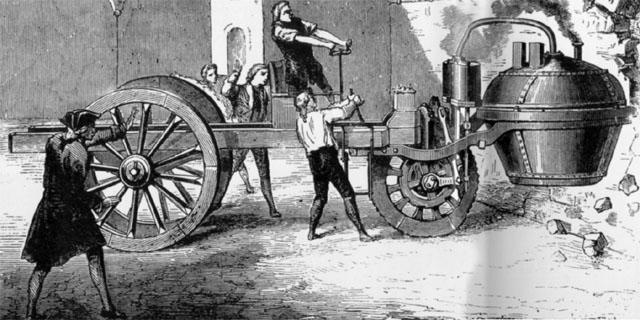
The first vehicle to move under its own power for which there is a record was designed by Nicholas Joseph Cugnot and constructed by M. Brezin in 1769. A replica of this vehicle is on display at the Conservatoire des Arts et Metiers, in Paris. I believe that the Smithsonian Museum in Washington D. C. also has a large (half size ?) scale model. A second unit was built in 1770 which weighed 8000 pounds and had a top speed on 2 miles per hour and on the cobble stone streets of Paris this was probably as fast as anyone wanted to go it. The picture shows the first model on its first drive around Paris were it hit and knocked down a stone wall. It also had a tendency to tip over frontward unless it was counterweighted with a canon in the rear. the purpose of the vehicle was to haul canons around town.
The early steam powered vehicles were so heavy that they were only practical on a perfectly flat surface as strong as iron. A road thus made out of iron rails became the norm for the next hundred and twenty five years. The vehicles got bigger and heavier and more powerful and as such they were eventually capable of pulling a train of many cars filled with freight and passengers.
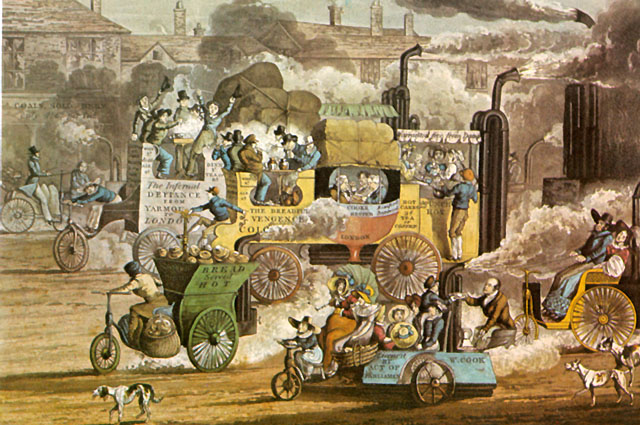 As the picture at the right shows, many attempts were being made in England by the 1830's to develop a practical vehicle that didn't need rails. A series of accidents and propaganda from the established railroads caused a flurry of restrictive legislation to be passed and the development of the automobile bypassed England. Several commercial vehicles were built but they were more like trains without tracks.
The development of the internal combustion engine had to wait until a fuel was available to combust internally. Gunpowder was tried but didn't work out. Gunpowder carburetors are still hard to find. The first gas really did use gas. They used coal gas generated by heating coal in a pressure vessel or boiler. A Frenchman named Etienne Lenoir patented the first practical gas engine in Paris in 1860 and drove a car based on the design from Paris to Joinville in 1862. His one-half horse power engine had a bore of 5 inches and a 24 inch stroke. It was big and heavy and turned 100 rpm. Lenoir died broke in 1900.
Lenoir had a separate mechanism to compress the gas before combustion. In 1862, Alphonse Bear de Rochas figured out how to compress the gas in the same cylinder in which it was to burn, which is the way we still do it. This process of bringing the gas into the cylinder, compressing it, combusting the compressed mixture, then exhausting it is know as the Otto cycle, or four cycle engine. Lenoir claimed to have run the car on benzene and his drawings show an electric spark ignition. If so, then his vehicle was the first to run on petroleum based fuel, or petrol, or what we call gas, short for gasoline.
Siegfried Marcus, of Mecklenburg, built a can in 1868 and showed one at the Vienna Exhibition of 1873. His later car was called the Strassenwagen had about 3/4 horse power at 500 rpm. It ran on crude wooden wheels with iron rims and stopped by pressing wooden blocks against the iron rims, but it had a clutch, a differential and a magneto ignition. One of the four cars which Marcus built is in the Vienna Technical Museum and can still be driven under its own power.
In 1876, Nokolaus Otto patented the Otto cycle engine, de Rochas had neglected to do so, and this later became the basis for Daimler and Benz breaking the Otto patent by claiming prior art from de Rochas.
 The picture to the left, taken in 1885, is of Gottllieb Daimler's workshop in Bad Cannstatt where he built the wooden motorcycle shown. Daimler's son Paul rode this motorcycle from Cannstatt to Unterturkheim and back on November 10, 1885. Daimler used a hot tube ignition system to get his engine speed up to 1000 rpm
The previous August, Karl Benz had already driven his light, tubular framed tricycle around the Neckar valley, only 60 miles from where Daimler lived and worked. They never met. Frau Berta Benz took Karl's car one night and made the first long car trip to see her mother, traveling 62 miles from Mannheim to Pforzheim in 1888.
Also in August 1888, William Steinway, owner of Steinway & Sons piano factory, talked to Daimler about US manufacturing right and by September had a deal. By 1891 the Daimler Motor Company, owned by Steinway, was producing petrol engines for tramway cars, carriages, quadricycles, fire engines and boats in a plant in Hartford, CT.
Steam cars had been built in America since before the Civil War but the early one were like miniature locomotives. In 1871, Dr. J. W. Carhart, professor of physics at Wisconsin State University, and the J. I. Case Company built a working steam car. It was practical enough to inspire the State of Wisconsin to offer a $10,000 prize to the winner of a 200 mile race in 1878.>(see more on J. W. Carhart story from Fredric Dennis Williams)
The 200 mile race had seven entries, or which two showed up for the race. One car was sponsored by the city of Green Bay and the other by the city of Oshkosh. The Green Bay car was the fastest but broke down and the Oshkosh car finished with an average speed of 6 mph.
 From this time until the end of the century, nearly every community in America had a mad scientist working on a steam car. Many old news papers tell stories about the trials and failures of these would be inventors.
By 1890 Ransom E. Olds had built his second steam powered car, pictured at left. One was sold to a buyer in India, but the ship it was on was lost at sea.
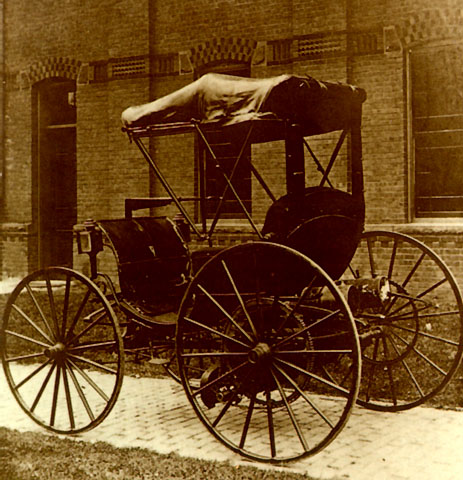 Running by February, 1893 and ready for road trials by September, 1893 the car built by Charles and Frank Duryea, brothers, was the first gasoline powered car in America. The first run on public roads was made on September 21, 1893 in Springfield, MA. They had purchased a used horse drawn buggy for $70 and installed a 4 HP, single cylinder gasoline engine. The car (buggy) had a friction transmission, spray carburetor and low tension ignition. It must not have run very well because Frank didn't drive it again until November 10 when it was reported by the Springfield Morning Union newspaper. This car was put into storage in 1894 and stayed there until 1920 when it was rescued by Inglis M. Uppercu and presented to the United States National Museum.
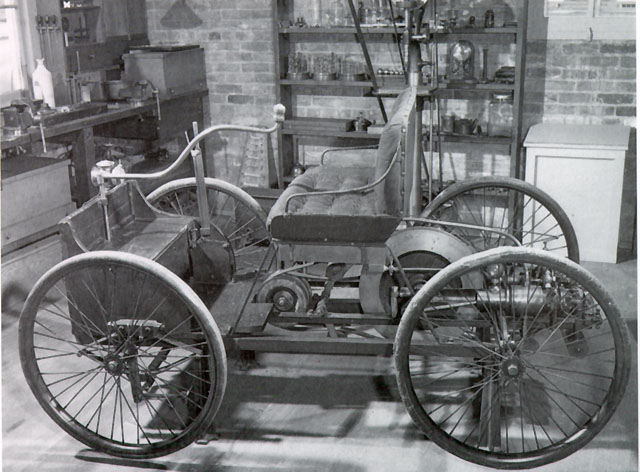 Henry Ford had an engine running by 1893 but it was 1896 before he built his first car. By the end of the year Ford had sold his first car, which he called a Quadracycle, for $200 and used the money to build another one. With the financial backing of the Mayor of Detroit, William C. Maybury and other wealthy Detroiters, Ford formed the Detroit Automobile Company in 1899. A few prototypes were built but no production cars were ever made by this company. It was dissolved in January 1901. Ford would not offer a car for sale until 1903.
 The first closed circuit automobile race held at Narragansett Park, Rhode Island, in September 1896. All four cars to the left are Duryeas, on the right is a Morris & Salom Electrobat. Thirteen Duryeas of the same design were produced in 1896, making it the first production car.
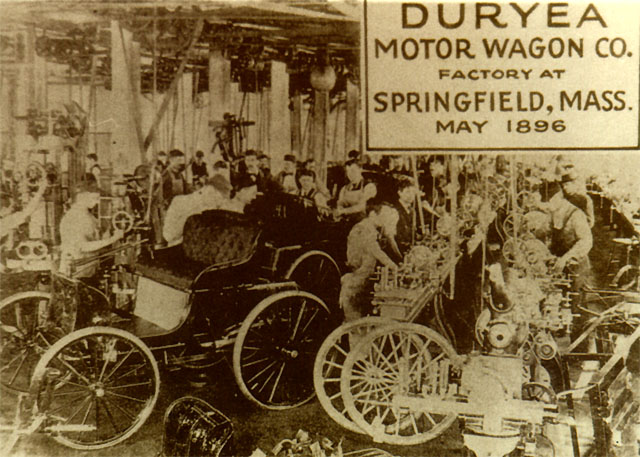 At left is pictured the factory with produced the 13 Duryeas. In 1898 the brothers went their separate ways and the Duryea Motor Wagon Company was closed. Charles, who was born in 1861 and was eight years older than Frank had taken advantage of Frank in publicity and patents. Frank went out on his own and eventually joined with Stevens Arms and Tool Company to form the Stevens-Duryea Company which was sold to Westinghouse in 1915. Charles tried to produce some of his own hare-brained ideas with various companies until 1916. Thereafter he limited himself to writing technical book and articles. He died in 1938. Frank got a half a million dollars for the Westinghouse deal and lived in comfort until his death in 1967, just seven months from his 98th birthday.
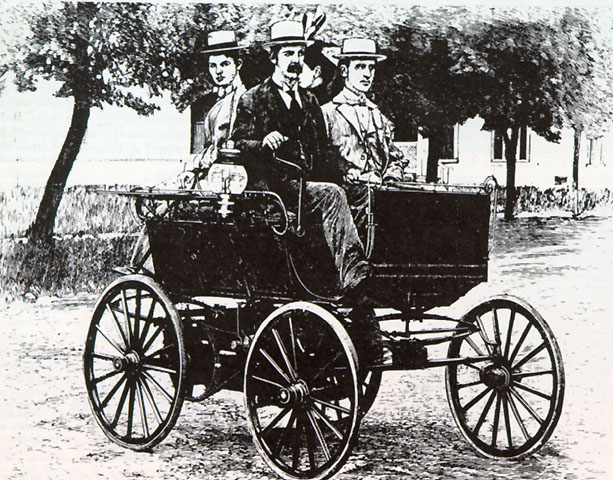 In this engraving Ransom Eli Olds is at the tiller of his first petrol powered car. Riding beside him is Frank G. Clark, who built the body and in the back are their wives. This car was running by 1896 but production of the Olds Motor Vehicle Company of Detroit did not begin until 1899. After an early failure with luxury vehicles they established the first really successful production with the classic Curved Dash Oldsmobile.
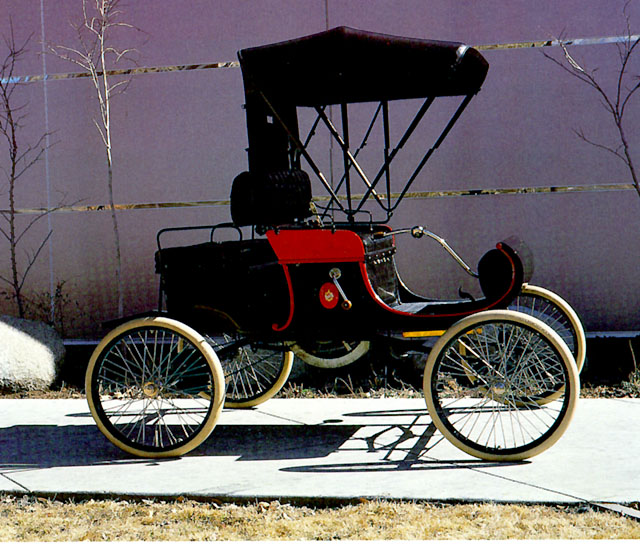 The Curved Dash Oldsmobile had a single cylinder engine, tiller steering and chain drive. It sold for $650. In 1901 600 were sold and the next years were 1902 - 2,500, 1903 - 4,000, 1904 - 5,000. In August 1904 Ransom Olds left the company to form Reo (for Ransom Eli Olds). Ransom E. Olds was the first mass producer of gasoline powered automobiles in the United States, even though Duryea was the first auto manufacturer with their 13 cars.
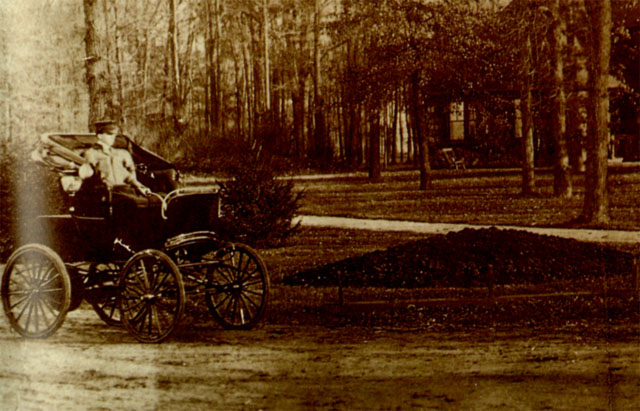 Ransom Olds produced a small number of electric cars around the turn of the century. Little is known about them and none survive. The picture at left is the only known picture of one of these rare cars. It was taken at was taken at Belle Island Park, Michigan. In 1899 and 1900, electrics outsold all other type of cars and the most popular electric was the Columbia built by Colonel Albert Augustus Pope, owner of American Bicycle Company.
an interesting footnote to the Olds electric.
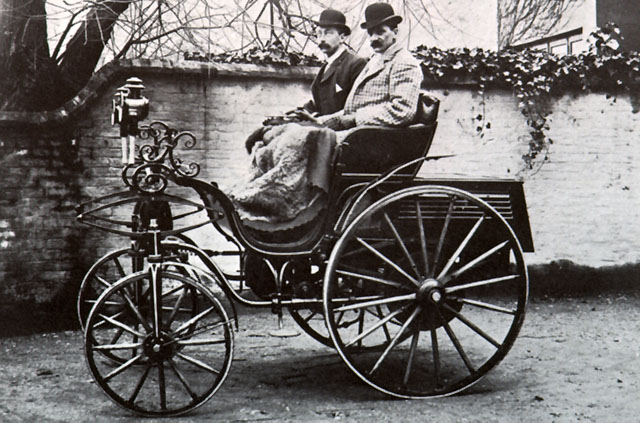 J. A. Koosen and H. Lawson in a 1895 Lutzmann. This is typical of American design in the mid 1890's. It was truly a horseless carriage. Tiller steering, engine under the floorboards, very high center of gravity, not designed for road travel. Imagine climbing into one of these and trying to drive across town and around a few corners. Kind of scary, huh?
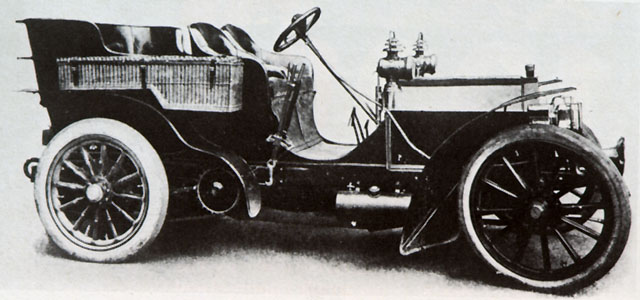 This Daimler of 1899 was owned by Lionel Rothchild. The European design is much advanced of the American designs of the same time. Gottlieb Daimler took part in the London-to-Brighton run in 1896 but died in 1900 at the age of 66 without ever meeting Benz. His German engines powered the automobile industries of Britain and France.
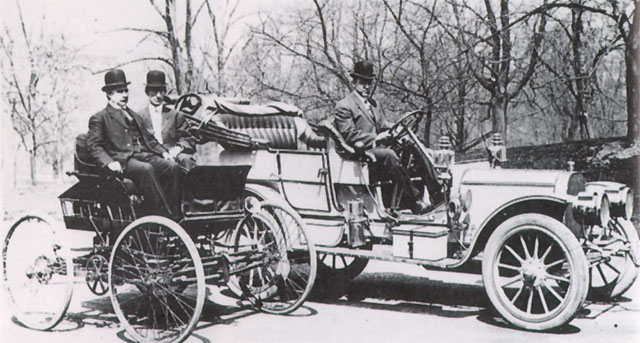 The 1908 Haynes in the back ground shows the rapid development of the petrol powered car when compared to the 1894 model in the foreground. Consider the present difference between a 1998 Tarus and the 14 year old 1984 Tarus. Some difference. Old man Haynes claimed to have build the 1894 car in 1893 but had no proof.
 The Rolls Royce Silver Ghost of 1906 was a six cylinder car that stayed in production until 1925. It represented the best engineering and technology available at the time and these cars still run smoothly and silently today. This period marked the end of the beginning of the automobile.
source

 Posts
Posts

